
Most companies treat “getting serious about AI” like it needs its own job posting. A Head of AI Enablement, a new director role, a specialist hired in from outside who understands the tools better than anyone already on the team. It doesn’t have to start that way. The version I actually lived through started with zero budget, zero headcount, and nobody’s permission. It started with one person on a marketing team deciding to actually use the tool seriously instead of just poking at it.
It starts with solving your own problem, not a company mandate
I came into a technical product marketing role from a different background than most of the team, not a hands-on network engineer, so the product itself had a real learning curve. Instead of grinding through documentation alone, I built a custom GPT, paid for out of my own pocket since building one takes a paid plan, and trained it on our own release notes, feature lists, and the handful of competitors we actually cared about.
I used it two ways. First, to learn the product fast, asking it to explain things in plain language until they actually clicked. Second, and this is the part that mattered more than I expected, to rehearse explaining features the way I’d actually need to explain them to someone else. That paid off directly at conferences. When a prospect hit me with an obscure question about how some feature actually worked, I already had a simple, relatable answer ready instead of a blank look, because I’d worked through it with the GPT first. Nobody assigned any of this. I built it because I needed it, on my own time, paying the cost myself.
The real test is whether someone else can use it, not just you
A personal shortcut is nice. It’s not a program. Word got around fast once this one actually worked. My CMO found out I’d built it for myself, got genuinely excited, and asked if I’d teach it to other people. I said yes, and that turned it from a personal habit into something people actually used.
I built a version for a BDR who needed help generating a real cadence of email follow-ups. He used it for a month or two, just long enough to get past the specific problem he was stuck on, then didn’t need it anymore, and that was fine, it didn’t have to be permanent to be worth building. I built another version on a salesperson’s own paid account, so they could work through a tough customer question live on a call instead of promising to follow up later. I built a third for a channel manager, same idea, answer the hard question live if you can, or take it home as homework and come back with a real, well reasoned answer instead of a guess. Three different roles, three different problems, the same underlying tool each time. That’s the actual bar for calling something a program instead of a hobby, whether it still works once it’s not just you using it.
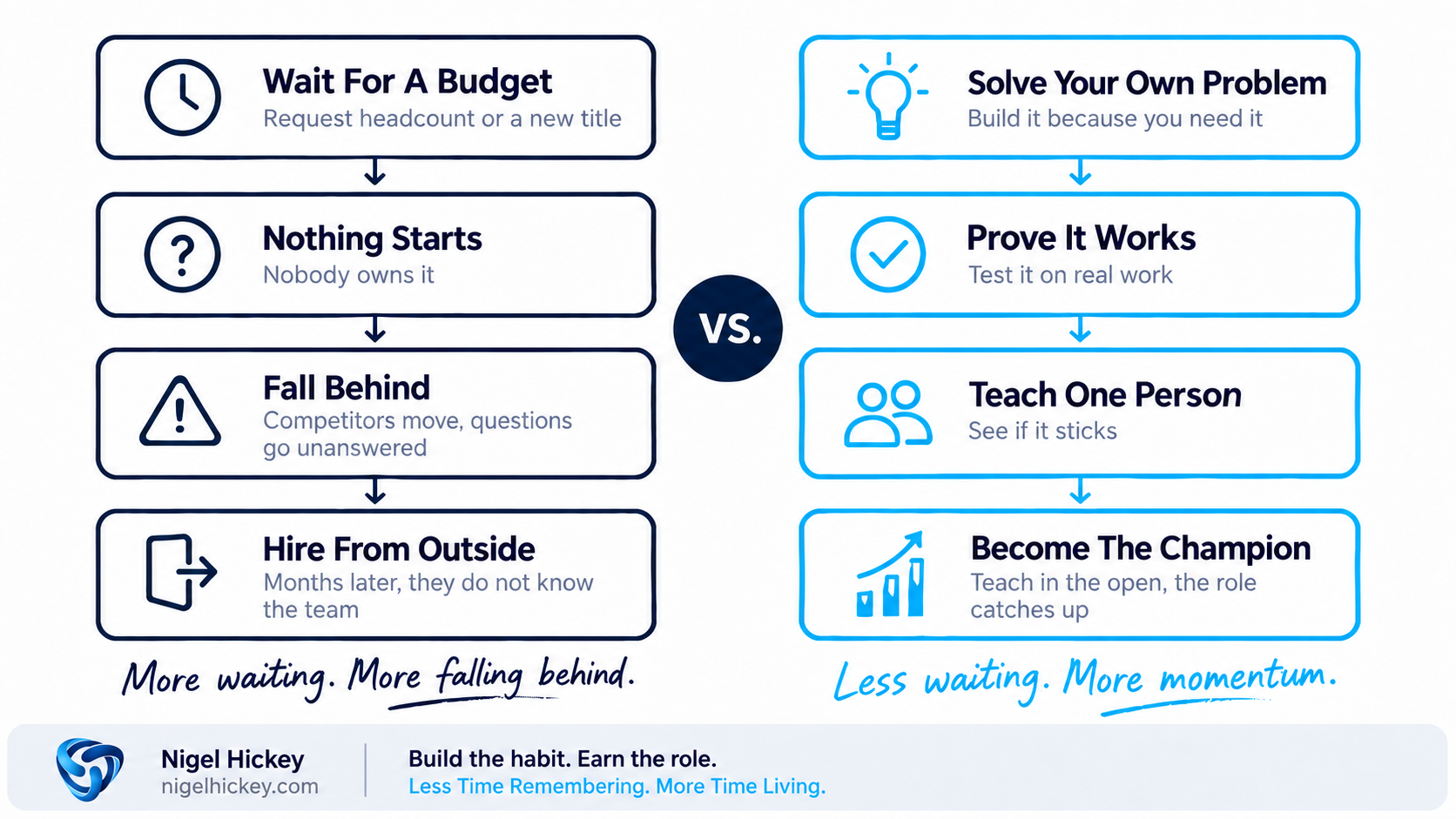
Publish it and teach it, don’t sit on it
Once something works for more than one person, the job changes from building to teaching. I started writing up what I’d learned, sharing real workflows instead of just results, and became the person the team pulled in whenever a technical or competitive question needed a fast, well researched answer. None of this required a training budget or an outside consultant. It required someone willing to document what they’d already figured out and teach it in the open instead of quietly keeping it as a personal advantage.
What this actually takes
No new hire. No dedicated budget. No permission slip, at least not at the start. It takes one person curious enough to solve their own problem first, disciplined enough to build something a teammate can actually use, and generous enough to teach it instead of quietly staying the only one who knows how. Most companies get the order backwards. They wait for a company-wide tool rollout and hope a champion appears afterward. It works a lot better the other way around, when the champion already exists and any official rollout just catches up to what’s already happening.
If your team is waiting on a dedicated AI hire before anyone touches these tools seriously in public, you may already have the person. They just haven’t been given room to do it out loud yet. Who’s already doing this quietly on your team, and what happens if you hand them the floor?
Where I can actually help
I get a version of this question a lot now. People read this kind of story and want to know what to actually do with it, depending on where they’re sitting.
If you’re the one already doing this quietly inside your own company, the fastest next step is usually a second set of eyes, someone who’s built this before and can tell you what’s actually worth doing next instead of guessing alone. If you’re running a small business and nobody’s doing any of this yet, you don’t need a full-time hire to start. You need someone to build the first real version, the way I built mine, then hand it off the way I did. If you’re at a bigger company and something like this already exists but it’s stuck in one specific gap, a competitive intelligence process that’s gone stale, an AI rollout that needs someone to actually make it stick, that’s usually a bounded project, not a new headcount either.
Tell me what’s broken. Someone with my experience means I can usually tell pretty fast what’s going on, and whether I’m the right person to jump in and implement the fix.