
I read a Wall Street Journal story a few days ago that made me laugh out loud at my desk. Cisco just rolled out a personal AI agent, called MyAgent, to all 90,000 of its employees worldwide. It’s personalized to each individual employee, Cisco’s own Executive Vice President of Operations, Thimaya Subaiya, told the Journal, not one shared assistant with everyone’s name stapled on top. One day you’re an employee with email and a laptop. The next, you’ve got an agent that actually knows your job and can go handle a chunk of your day for you.
Here’s why it made me laugh. Handing everyone a working AI agent sounds like the kind of thing that takes a company two years, a steering committee, and a change management consultant. Cisco just did it, all 90,000 people, in one move. The actual reason wasn’t some grand AI strategy either. Too many different AI tools were already scattered across the company, and the fix was consolidating all of it into one thing every employee actually has.
What Cisco actually built
It’s worth being specific here, because “AI agent” gets used for everything from a chatbot to a genuine coworker, and those are not the same thing. Each employee’s agent pulls context about them in real time through secure enterprise connectors tied to their existing permissions, and it only works for the one person it’s assigned to. Subaiya was clear about that boundary. The agents don’t talk to each other and they don’t talk to other employees, only to their own person, and anything that leaves the sandbox still needs a human to sign off on it. “I truly believe that you cannot replace humans entirely with AI,” Subaiya told the Journal. “What you can do is very successfully augment people with AI.“
On the back end, each agent can call on more than 800 subagents built to handle narrower slices of work, things like watching a sales forecast for a variance and firing off an anomaly alert on its own. Cisco also built what it calls a policy server, which stops an agent from doing something like deleting a data set, and keeps Cisco’s own data from training someone else’s model. Running an always-on agent for 90,000 people gets expensive fast, so Cisco uses a token monitoring tool from Splunk, the cybersecurity and analytics company it bought in 2024, plus its own “intelligent router” that sends each request to whichever model actually fits instead of defaulting to the biggest one every time. By Cisco’s own numbers, 50 to 60 percent of requests get handled by open weight models running on Cisco’s own GPUs, another 20 to 30 percent by plain software automation with no model involved at all, and only a small remainder needs a full frontier model.
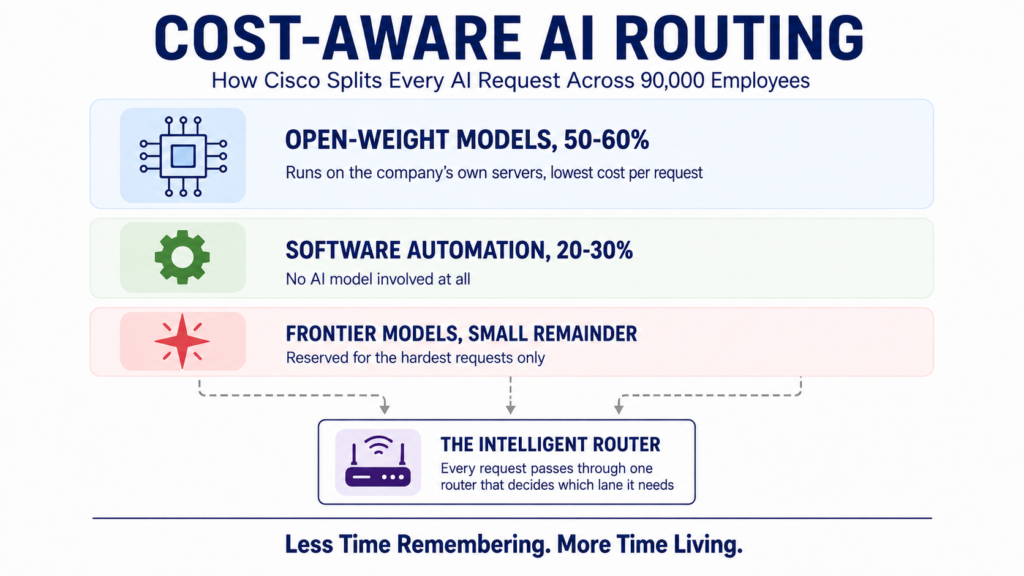
That’s a genuinely sensible design. Real permission boundaries, a policy server instead of blind trust, cost aware routing instead of one model for everything. It’s also, and I mean this as a compliment, close to the shape of system I’ve been running for myself for months now, just at a party of one instead of ninety thousand.
The part that isn’t about Cisco at all
I built my own version of this a while back. Not a chatbot I open when I remember to. An actual agent, running daily, that knows my calendar, my email, and my ongoing projects, and picks up work without me re-explaining myself every single morning. It drafts, it tracks, it reminds me of things I would have otherwise let slip, and it does it inside the same kind of system Cisco just described, where context carries forward instead of starting from zero every session.
The lesson I’d already learned the hard way, long before I read about MyAgent, is the one Cisco is about to relearn at scale. The agent isn’t actually the hard part. The habit of trusting it, feeding it real context, and treating it like a coworker instead of a search bar, that’s the real work. Cisco is also rolling this out in a year that’s brought AI linked layoffs across the industry, so it’s a fair bet plenty of those 90,000 people are feeling some version of the same thing, real curiosity about what the agent can do, and a little nervousness about what “everyone gets an agent” really means for their own job. That’s not a knock on the idea. It’s just the honest part that never makes it into the press release.
Why this matters if you don’t have 90,000 employees
Here’s the part I actually want a small business owner reading this to walk away with. You don’t need Cisco’s budget or Cisco’s engineering team to get the same shape of benefit. The version that matters for a barber shop, a dentist’s office, or a two person CPA practice isn’t “give everyone a personalized enterprise AI platform.” It’s picking the one workflow that’s quietly draining your week and building an agent for exactly that.
Maybe it’s the phone that rings while you’re mid appointment and the caller just hangs up instead of leaving a voicemail. Maybe it’s the eleven PM email asking for a quote that sits unanswered until you open your laptop the next morning, by which point they’ve already booked someone else. Those aren’t ninety thousand employee problems. They’re one person problems, and they’re exactly the kind of thing a correctly sized agent handles well. That’s the whole idea behind Less Time Remembering. More Time Living. Cisco just proved the concept at the largest possible scale. You can prove it for yourself at the smallest.
Where I think this goes
I don’t think MyAgent itself is the interesting story. The interesting story is that a company with 90,000 employees looked at its own pile of scattered AI tools and decided the fix wasn’t one more app bolted on top, it was giving every single person one agent that actually knows their job. That’s the same decision, just at a different size, that I made for myself a while back, and it’s the same decision I think most small businesses are going to end up making in some form over the next couple of years. Not because it’s trendy. Because doing the same repetitive work by hand forever stops making sense once the tool to fix it is sitting right there.
What’s the one thing in your week that keeps eating time it shouldn’t? That’s usually where the first agent worth building actually starts.