
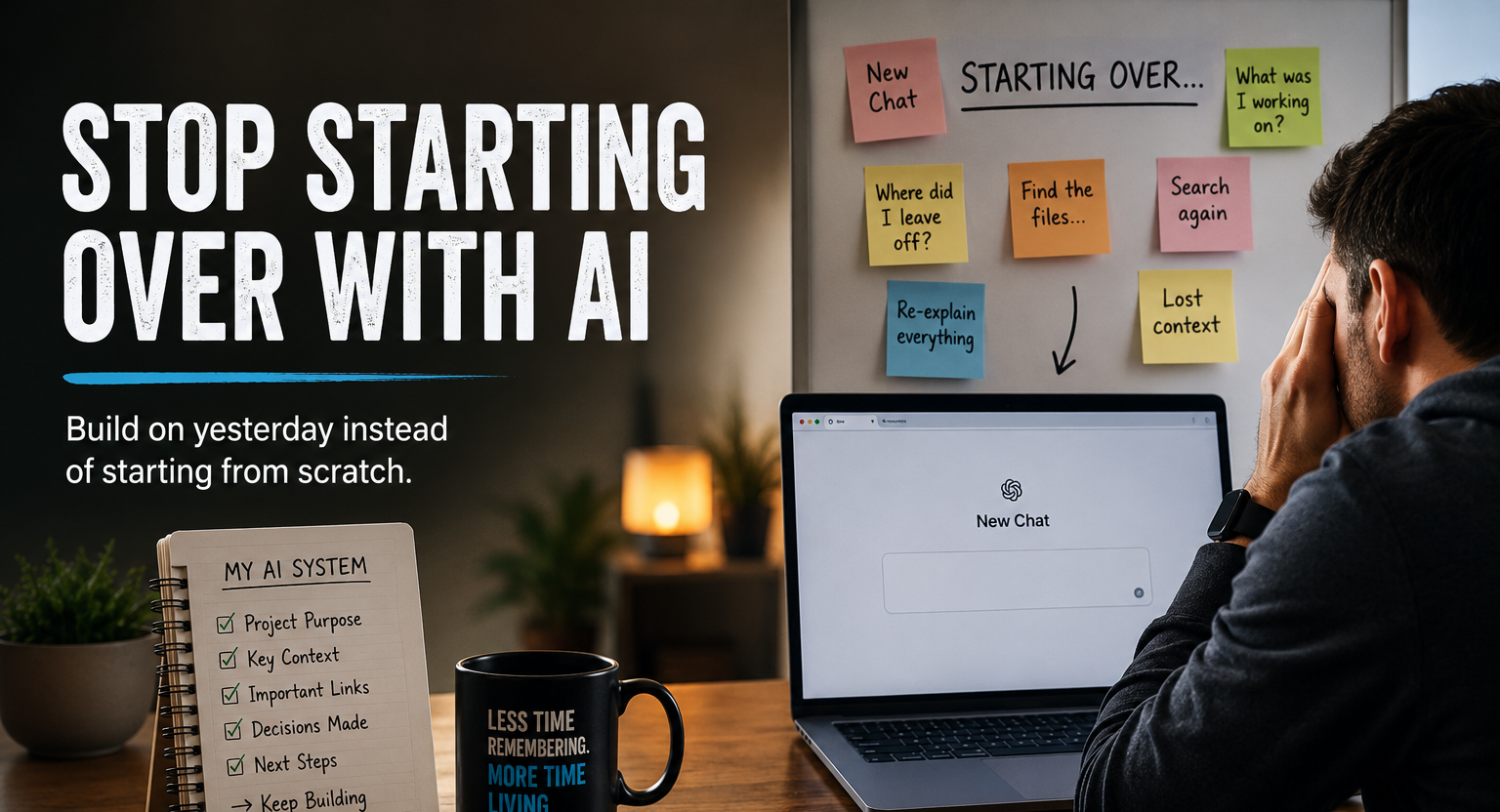
I caught myself doing it again a few weeks ago. New chat, blank window, and the first thing I typed was three paragraphs of background I had already written somewhere else. Who I am. What I am working on. What I had already decided. What I did not want to hear again. By the time I got to the actual question, I had spent ten minutes rebuilding context that existed the week before and then quietly evaporated when I closed the tab. If that sounds familiar, keep reading. This is about how to stop starting over with AI.
Most people are still using AI like search. Open the app, ask a question, get an answer, close the app, come back later and start from zero. For quick questions there is nothing wrong with that. I do it too. Sometimes I just want to know how long something should cook, what an error message means, or whether there is a better way to word an email.
The problem shows up when you try to use AI for something that matters over time. A trip you are planning. A book you are writing. A job search. A home project. Family information, content ideas, a business you are trying to think through. The quick question and answer model falls apart there, because the important part is no longer the question. The important part is the context behind it. Who you are, what you are trying to accomplish, what you already decided, what you like, what you want to avoid, what has already been tried, and what is still unresolved.
Open a fresh conversation every time and you throw all of that away. Then you spend your time rebuilding it. That is when AI starts to feel strangely frustrating. You know it can help, but somehow you keep explaining yourself to it.
There is a better way to stop starting over with AI, and it has almost nothing to do with prompts.
The Real Problem Is Not Your Prompt
There is no shortage of advice about how to write the perfect prompt. Giant lists, prompt packs, formulas, people selling magic words that supposedly unlock the hidden power of AI. I am not going to pretend prompts do not matter. Clear instructions help. But after using this stuff heavily for a couple of years, I do not believe the real advantage comes from having the cleverest prompt. It comes from context.
The better an AI understands what you are trying to accomplish, what matters to you, what you have already decided, and how you prefer to work, the more useful it becomes. That sounds obvious written down, and it still changes everything in practice.
Instead of asking what the best place to stay in Germany is, you can work inside a project that already knows the basics. Where you’ve been. Which airport you fly out of. Whether you prefer hotels or apartments. Your budget, your food preferences, who you travel with, which cities you’ve already considered, and which ideas you already rejected. The question is no longer starting from zero.
I Learned This Almost by Accident
I started using ChatGPT in 2024 after a friend showed me how he was using it. I was not looking for a productivity system. I was trying to solve real problems.
Later that year I was interviewing at NetBrain. Like any interview process, there was a lot to keep track of. Who am I meeting. What is their background. What does the company actually do. Who are the competitors. What did I learn last round. What should I ask next. Normally that lives in browser tabs, scattered notes, LinkedIn profiles, and whatever I happen to remember on the day.
Instead, I fed all of it into one dedicated workspace. Every interview added context. Every conversation made the thing more useful. There was no grand AI strategy behind it. I was trying to prepare better and stop losing information.
Then something interesting happened. I got the job, and the system was still useful. So I kept building it. That same discipline, one file, a real cadence, a person still deciding what matters, is also what I later built into an AI agent that tracks competitors for a marketing team.
What started as interview prep turned into something much larger, and the same principle kept proving itself. The more relevant context I preserved, the less I had to reconstruct later. Travel planning, recipes, health notes, writing, family information, content ideas, work projects, research, even gaming. At some point I realized I was not collecting random chats anymore. I was building ongoing systems around the things that actually matter to me.
Stop Making Yourself Repeat Everything
Travel is the easy example for me, because my partner and I travel quite a bit and every trip carries details that matter. We usually fly out of Dallas. We lean toward American Airlines when it makes sense. We have hotel preferences, food preferences, a budget, and a running list of things we learned the hard way on previous trips. Some destinations are already ruled out. Some dates are already locked. I do not want any of that mixed in with ideas we are only kicking around.
None of those details are complicated on their own. Together they completely change the quality of the help I get. Start a brand new chat every time and I have to explain all of it again, which means I am not saving time. I am rebuilding something I already had.
The same thing happens with a job search, a home renovation, a writing project, family history, health notes, or anything else that continues over months. I’ve since pointed this same habit at something that has nothing to do with work. My kitchen pantry, for one.
And the repetition is only half of it. The bigger problem is that useful information gets scattered across conversations. Now you have to remember which chat had the final answer, which one had the better idea, and which decision you actually made.
That is exactly the kind of mental clutter I want AI to take off my plate. My goal is not to get more answers out of it. My goal is to carry less around in my own head.
Give the Project a Purpose
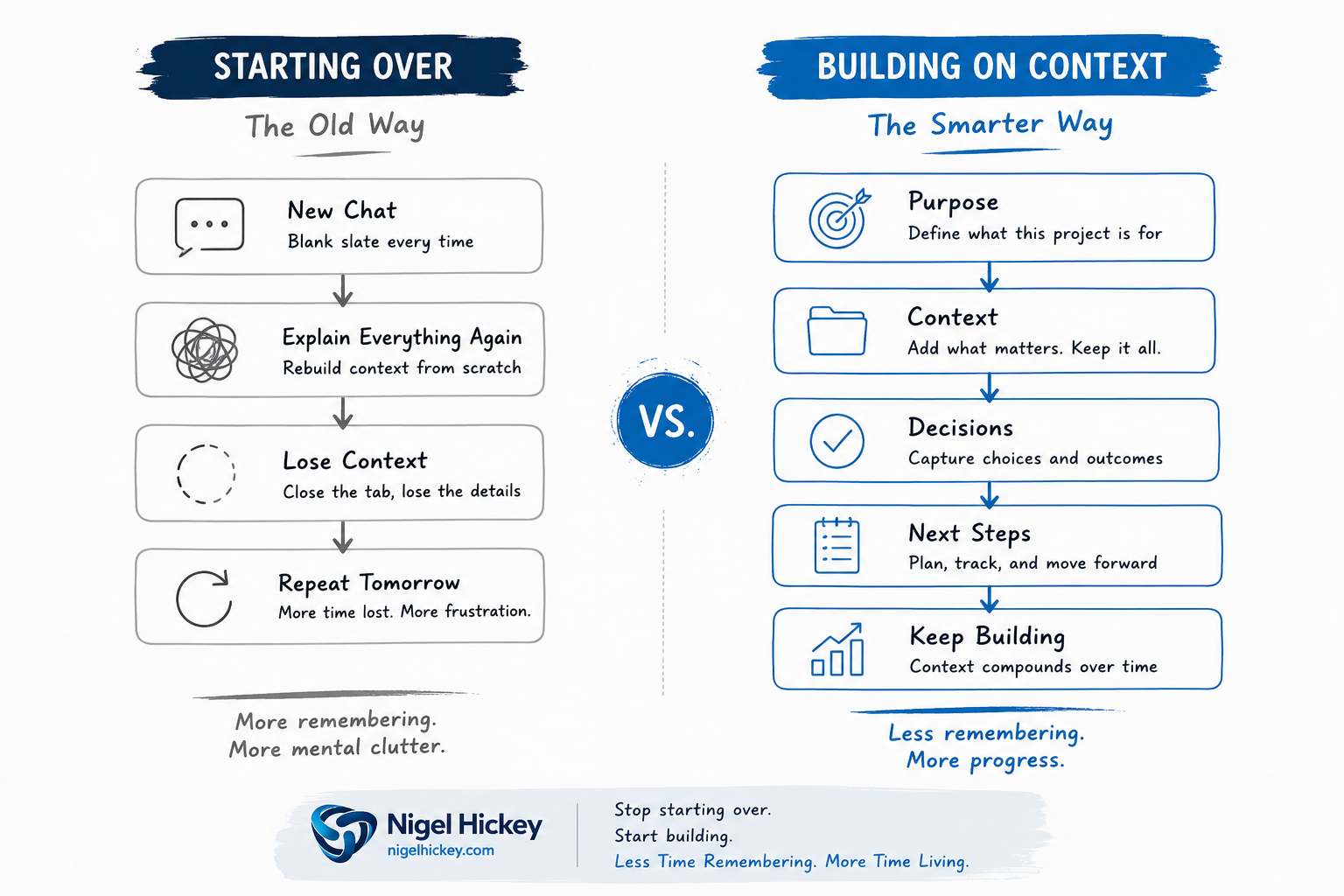
The easiest place to start is telling the AI what the project is for. Not a technical spec. Just say it plainly.
“This project helps me plan family travel without digging through old messages, reservations, notes, and websites every time we go somewhere.”
One sentence, and the AI already has direction. It knows what the project is and what problem it is supposed to solve. From there I add a few more things: what success looks like, what the AI should know about me, what my current priorities are, what has already been decided, what belongs in the project, what stays out, and how I want it to help.
You do not need a forty page operating manual before you begin. You do not need to understand code. You do not need three hours and the perfect setup. You need enough context that you are not starting over every time.
Five questions get you most of the way there:
- What is this for?
- What am I trying to accomplish?
- What should the AI know?
- What have I already decided?
- What should stay out of this project?
Those sound almost too simple, and that is the point. They create clarity early, before the project turns into a mess.
Tell It How to Behave
It also helps to tell the AI how to behave. The thing that frustrates me most is a system that keeps reopening decisions I already made. If I approved a direction last week, I do not want it redesigned every time we come back to the subject. So I give it a rule: treat approved decisions as intentional unless I ask to revisit them, unless new information creates a contradiction, or unless something is clearly not working in the real world. Otherwise, keep building. That one instruction saves a surprising amount of wasted time.
Same goes for stray ideas. Good ones show up when they show up, but that does not mean they all deserve attention right now. I keep a parking lot for ideas worth preserving that do not belong in the current task. I do not have to remember them, and they do not derail what I am working on.
The point is not complexity. The point is continuity.
Context Compounds
This is the biggest lesson I have taken from using AI every day. One preference does not seem important. One decision does not seem important. One note from one conversation does not seem important. Over time, those pieces start working together.
The system starts to understand the patterns. What you like, what you avoid, what you already tried, what tends to work, what wastes your time. Future conversations get faster, more relevant, and more useful, and you stop carrying so much of it around yourself. That is a much bigger benefit than getting a better answer to one question. It is less mental weight.
A good system is not valuable because it knows everything. It is valuable because it knows enough about the right things to help you move forward without rebuilding the foundation every time.
A Trusted Coworker, Not a Vault
One important caution here. More context does not mean handing over everything.
The rule I use: treat AI like a trusted coworker, not like a vault. I am comfortable sharing preferences, goals, project history, travel ideas, writing notes, research, and the running record of what we decided. I am not handing over passwords, banking credentials, recovery codes, identity documents, or sensitive information that belongs to someone else.
Call it minimum effective context. Give it what it needs to help, not everything you know. There is no prize for oversharing, and there is no reason to hand over information that does not improve the outcome. Good judgment still applies.
Start With One Real Problem
The other mistake is thinking you need to design the perfect AI setup before you begin. You do not.
Start with one project. One real problem. One place where you are tired of repeating yourself. Planning a trip. Organizing family recipes. Tracking a renovation. Prepping for interviews. Managing ideas for a book. Give the project a purpose, add some context, tell the AI what matters, tell it what is already decided, and tell it how you want it to help. Then build from there. You can always improve the structure later.
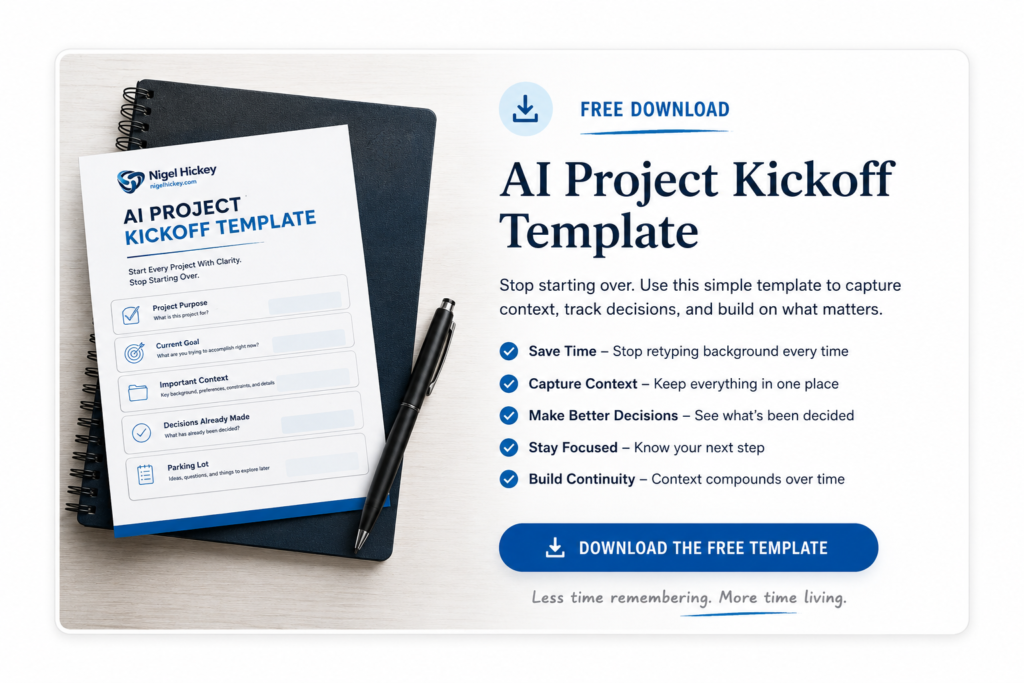
To make that easier, I put together a simple AI Project Kickoff Template. It is for people who use ChatGPT, Claude, or another assistant and keep ending up with disconnected conversations, repeated explanations, and lost context. It walks through the basics. What the project is for. What success looks like. What the AI should know. What your priorities are. What has already been decided. What belongs and what does not. How you want the AI to help. It includes a parking lot for future ideas and a few privacy guardrails.
You do not need every section. You do not need to fill it out perfectly. You just need enough structure to stop starting from scratch.
Ready to Stop Starting Over With AI?
If you have ever opened a new AI chat and found yourself explaining the same project all over again, this template is for you.
It is the same framework I use to stop starting over with AI: give a project a purpose, preserve important context, capture decisions, and keep things moving instead of rebuilding every time.
It lives in my GitHub repo. Clone it, copy it, make it your own. Free to grab. No gate, no signup.
Final Thought
The human brain is very good at thinking, creating, solving problems, and making connections. It is not good at carrying hundreds of loose details around forever without getting tired. That is where a trusted system earns its keep.
The goal is not to give AI your entire life. The goal is to stop spending your mental energy remembering things a well built system can hold for you.
Start small. Build on what works. Stop starting over.