
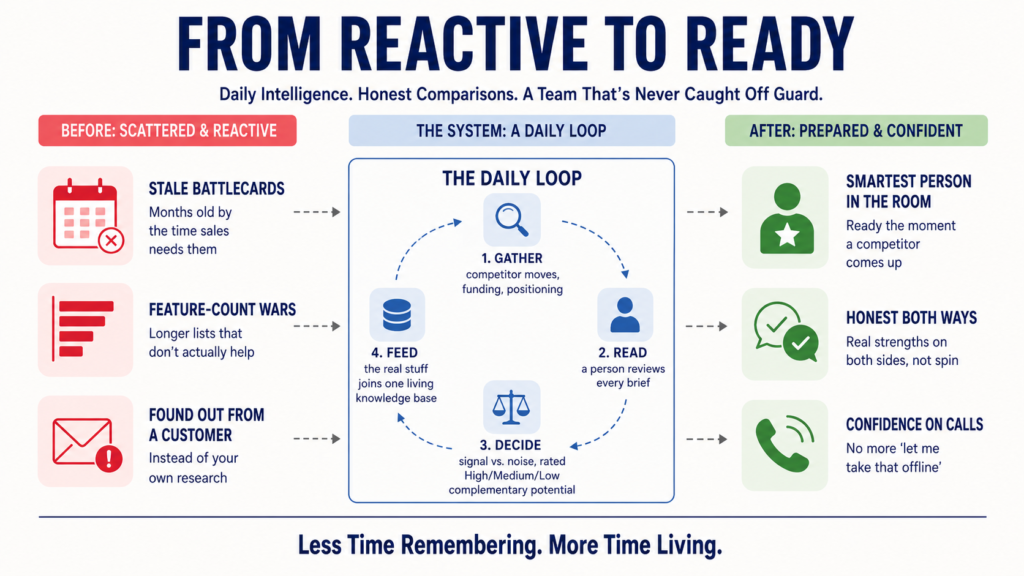
Every marketing team I’ve ever worked on has the same competitive intelligence problem. Someone owns it as a side project. The battlecards are eight months old by the time sales actually needs them. A competitor makes a move, and you find out from a customer instead of from your own research.
I inherited a version of this problem firsthand. What was there had been built entirely by hand, one manual research pass and one document at a time, and it showed: out of date by a year or more, and most of them weren’t briefs, they were novels. Some ran twenty or thirty rows deep on feature by feature comparison charts: we have this many features, they have this many. It read like a features race, and it didn’t actually help anyone sell. Arguing you’re better because your list is longer doesn’t tell a customer what you’re good at or why it matters to them.
So I threw most of it out and started over, with a real, short list of the competitors we actually ran into instead of an open ended pile of anyone who claimed to do something similar, and with AI built into the fix from the start.
The problem with competitive intelligence isn’t research. It’s cadence.
Nobody’s short on ways to research a competitor. What’s actually missing is someone doing it every single day, without fail, and turning it into something usable instead of a folder of half-read tabs.
Doing that daily started out manual, so I trained a custom AI assistant on our own product, our release notes, our features, and what made us different, so I could ask it questions and learn the product fast myself. Then I fed it competitor material, public white papers, screenshots of competitor websites, and had it help me build fair, side by side comparisons: three things we did better, three things they might do better, plus quick, honest answers to the objections sales heard most often. Comparing by category instead of counting features, and never pretending the comparison only ran one way, is the same discipline I later built into an AI agent that does it for me every morning.
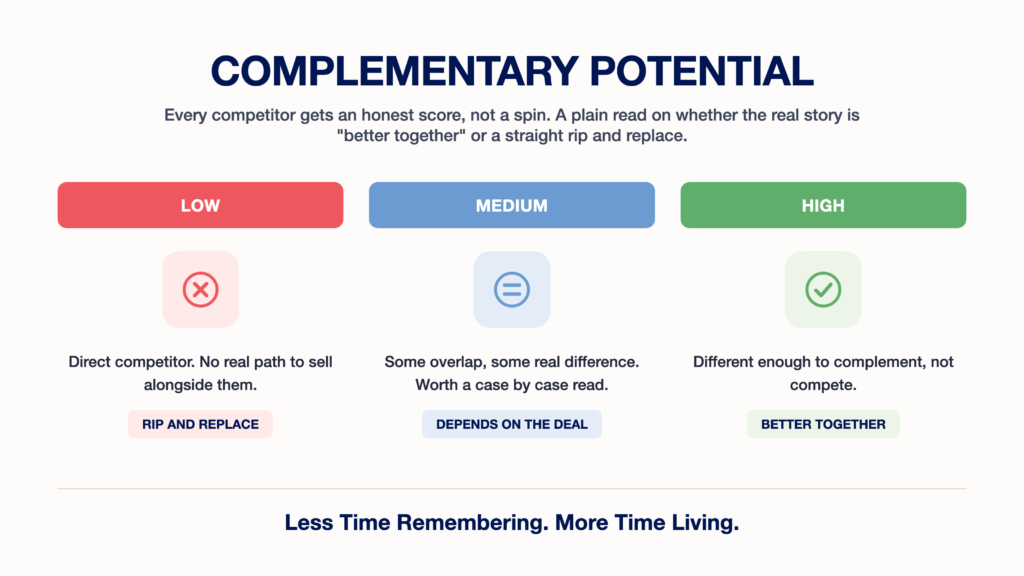
Sales kept wanting to tell a “better together” story instead of a rip and replace one, and they had no way to do it. So I invented a rating for each competitor, a Complementary Potential (CP Rating) score of High, Medium, or Low, with a plain explanation of how and why we actually complemented that specific competitor instead of just competing with them. Some scored high because there was a real path to sell alongside them. Others scored low because there wasn’t, and pretending otherwise would have just confused the sales conversation.
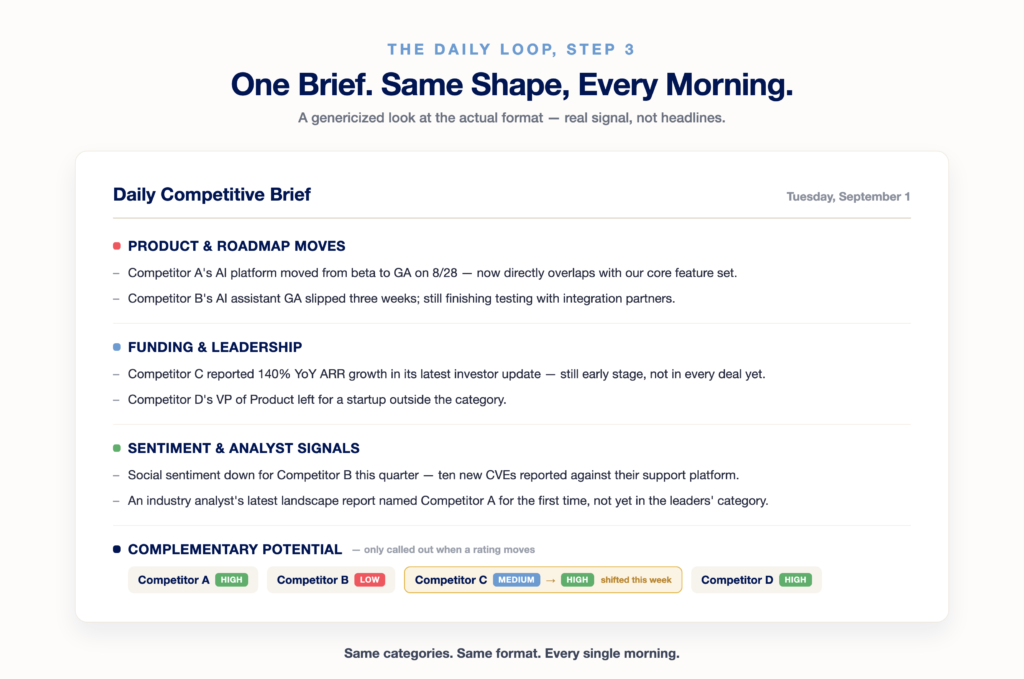
So now, a scheduled job pulls together what’s moved in my category: Competitor Announcements, Funding News, Leadership Changes, or even shifts in how they’re positioning themselves. It comes back as one clean markdown file, the same format every time, so I can scan it in two minutes with coffee instead of losing an hour to it.
The habit that made it actually work: I never treated the output as final.
This is the part people skip. An AI agent that just dumps information on you every morning is noise, not intelligence. What made this useful was the loop…I read the brief, I decided what mattered, and I fed the real stuff into a living knowledge base I already had going, the actual reference the whole team used for competitive deals.
I learned that discipline the hard way, long before this version of the tooling existed. People would message me in the middle of a sales call wanting an instant answer on a competitor they’d just run into. The easy thing would have been to react immediately. Instead I made myself research it first, even when it meant asking someone to wait a few minutes. Research before reacting is exactly what keeps a daily briefing useful instead of just noisy. The AI can gather instantly. The judgment about what’s actually true and what matters still can’t be rushed.
Six months in, I pulled that accumulated history into one competitive intelligence report showing exactly where we’d pulled ahead in the category, real trend lines, not just a gut feeling. That report ended up in sales calls and helped reinforce claims we were already making in analyst conversations, except now they had a paper trail behind them.
Three things had to be true for this to actually work:
- It had to run on a real cadence, not “whenever I remembered.” Daily, no exceptions, is what turned this from a nice idea into infrastructure.
- It had to come back in the same shape every time. Same format, same categories, every morning. That’s what made it scannable instead of another thing to read closely.
- A person still had to be in the loop. The AI gathers. I decide what’s signal and what’s noise, and only the real stuff makes it into anything anyone else sees.
None of this was ever about me. I didn’t need the credit. The real goal was making the salesperson the smartest person in the room the moment a competitor came up, whether that meant pulling it up on their phone or laptop mid conversation, or reading it the night before to prep for a call. They could walk in ready to talk through the comparisons and the differentiators instead of promising to “take it offline” and follow up later.
The bigger shift was never really the tooling. It was confidence. Once people trusted that every competitor claim had already been checked and put in honest context, they stopped being afraid of the word “competitor” on a call. They didn’t need a longer feature list. They needed the truth, delivered on time, in a format they could actually use, and someone willing to teach them how to say it.
None of this needed a data science team or a six-figure tool. It needed someone willing to treat AI like a real hire doing real research, not a chatbot you poke at when you remember to.
If your team’s competitive intel still lives in someone’s head and a stale slide deck, this is fixable, and it’s a lot more available to you than it looks.
Less time chasing the competition. More time acting on what you actually know.
As a first hand beneficiary of Nigel’s work, I can safely say that this intelligence has been invaluable in taking sales calls with partners and customers to the next stage. Having an up to the minute view of the competative landscape as well as being able to use that information confidently and in a consultative way, has forging long term trusted partnerships with experts in their respective fields, as well as being able to qualify opportunities much better. The poof of the pudding is the partner base and pipeline which has been growing beyond all expectations over the last 18 months.
Pingback: How to Give AI Context (Stop Starting Over)